What is SHMS?
SHMS (Shipping House Management System) is an integrated ERP platform engineered for international freight forwarding, logistics, and customs brokerage companies. It runs the whole shipment lifecycle across road, sea, and air: warehouse receiving, consolidation, customs clearing, and final delivery.
The platform closes the gap between physical cargo tracking and strict customs compliance. Import-license quotas are deducted in real time, so a branch never over-imports beyond what the license allows. Every branch works from one shared, auditable record instead of spreadsheets, paper receipts, and chat threads.

Shipping Pain Points & How SHMS Solves Them
International logistics suffers from weight and volume discrepancies, fragmented tracking across transport legs, and legal risk from importing beyond licensed allowances. Each capability in SHMS answers one of these problems directly.
Scattered Information
Receipts on paper, shipment details in spreadsheets, customs documents in email. No single source of truth.
Every Shipment in One Place
Each consignment, with its goods, weights, sizes, documents, and status, lives in one centralized record the whole team reaches instantly.
“Where Is My Shipment?”
Customers call constantly and staff lose hours hunting for a status nobody can answer with confidence.
Live Status & Customer Self-Tracking
Every job has a live status. Customers check their own shipment by job number and access code, with a customer-facing status you control.
Branches Out of Sync
The shipping branch and the clearing branch see different data, so goods and documents fall through the cracks.
Connected Branches
Shipping and clearing branches work on the same job, each with permissions tailored to its location.
Customs Chaos & Quota Overruns
Import-license quotas, declarations, and bills of lading are tracked by hand, and quotas get overrun before anyone notices.
Automated License Balance Clearance
Each clearance checks the import license and deducts the declared weight and value from its remaining balance in real time.
No Real Numbers
Management can’t answer “how many shipments this month, by branch, by type?” without a manual count.
Numbers on Demand
A live dashboard and one-click Excel reports show volumes by branch, transport type, warehouse, and customer.
Weight Errors & No Access Control
Weights and volumes are calculated by hand and get it wrong. Everyone sees everything, or the one person who knows is on holiday.
Auto-Calculation & Branch-Scoped Roles
Weight, volume, and volumetric weight are calculated by the system, and each employee sees only their branch and their function.
What the Platform Was Built to Achieve
Four strategic goals shaped the architecture, from the data model to the user interface.
End-to-End Visibility
Granular status tracking at three structural levels: receipts and shipments, individual goods line items, and master transport jobs.
Automated License Compliance
Real-time quota deduction and legal validation that prevent regulatory fines and cargo seizures at border crossings.
Operational Efficiency
No more human calculation errors in gross weight, volume (CBM), volumetric weight, and package distribution.
Multi-Modal Integration
One documentation flow for sea, land, and air, connecting ocean containers, trucks, boxes, and transport bills of lading.
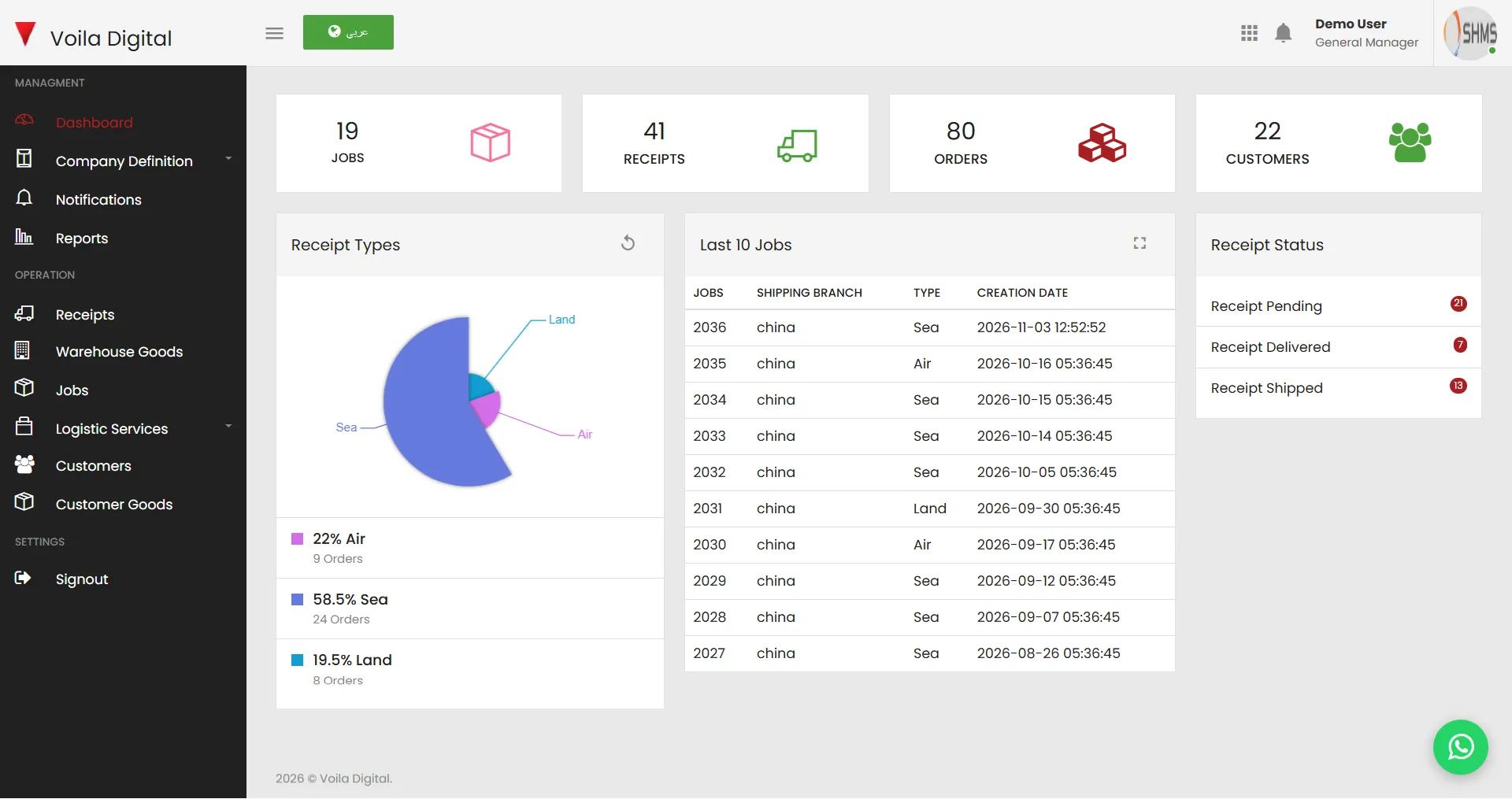
A Dashboard That Answers the Real Questions
The moment management logs in, they see the health of the operation. No report to request, no analyst to wait for. Click the screenshot to explore it full screen.
From Warehouse Door to Delivered & Cleared
SHMS follows the goods through every real step of the business. Status changes and license balances update automatically as cargo moves.
Cargo Intake, Measurement & Warehousing
The lifecycle starts when a client drops goods at an origin branch warehouse. Staff issue an intake receipt, then break the cargo lot into individual line items recording carton counts, gross weight, physical dimensions, volumetric calculations, product description, brand/markings, and warehouse position.
- One receipt per drop-off, many goods line items beneath it
- Weight, volume (CBM), and volumetric weight calculated by the system
- Receipt and goods both start as Pending, stored and awaiting a mission
Mission Planning, Consolidation & Transit
Operations supervisors create a master transport job defining the route, branch responsibilities, and estimated departure and arrival dates. Goods from different receipts are assigned to the job, and ocean containers or overland trucks, together with the legal shipping bills, are attached to it.
- Goods move from Pending to Sent as they are allocated to a job
- A receipt becomes Sent once all its goods are allocated
- The job becomes Shipped when the transport unit departs
- Consolidation maximizes container and truck space and reduces transit cost
Border Arrival, Declaration & License Settlement
When the job reaches the border checkpoint or port of entry, a customs declaration is registered. The platform checks the client’s import license for available weight and financial quota, then deducts the exact weight and value of the declared cargo from the remaining balance.
- Automated clearing calculation against the legal license
- Every deduction is recorded per clearance event
- Once verification completes, the job is marked as cleared
Destination Arrival, Verification & Handover
The job reaches the destination branch warehouse and the actual arrival date is recorded. After unloading and checking the physical packages against the transport manifest, the local team hands the cargo to the final customer and confirms delivery in the system.
- Goods, receipt, and job all complete as Delivered
- Real arrival date and delivery flags recorded
How Statuses Change at Every Step
The system updates the status of goods, receipts, and jobs automatically as each event happens.
| Action / trigger event | Goods | Receipt | Job |
|---|---|---|---|
| Cargo intake into warehouse | Pending | Pending | N/A |
| Goods assigned to a job | Sent | Pending (partially loaded) | Incomplete |
| Final goods of a receipt assigned | Sent | Sent | Incomplete |
| Departure triggered | Sent | Sent | Shipped |
| Final delivery confirmed at destination | Delivered | Delivered | Delivered |
20 Integrated Modules, One Connected System
Operational modules run the shipping lifecycle, master-data modules are configured once, and platform modules provide cross-cutting services. These are the core ones.
Receipts (Shipments)
The intake receipt issued at drop-off, with customer, supplier, receiving warehouse, and overall shipment status.
Warehouse Goods (Orders)
The smallest trackable unit: cartons, gross weight, dimensions, volumetric weight, description, markings, and warehouse position.
Jobs
The master transport mission. Aggregates goods and links them to transport modes, shipping and clearing branches, and ETD/ETA.
Logistic Services
Import licenses, customs declarations, and bills of lading, with automatic quota clearing.
Customers & Goods Catalog
Customers, sub-customers, contacts, access codes, and the catalog of goods each customer ships, with HS codes.
Branches & Warehouses
Country branches and their warehouses and sub-warehouses, each with English and Arabic names and active toggles.
Dashboard & Reports
Aggregated KPIs and operational reports across warehouses, jobs, licenses, declarations, and customers.
Notifications
Role-broadcast, real-time alerts delivered live and stored in an in-app feed with an unseen counter.
Core, Attachments & Backup
Users, roles, permissions, menus, login, file uploads against records, and database backup management.
See SHMS at Work
Real screens from the live platform, grouped by the part of the operation they serve. Click any screenshot to open it full screen.
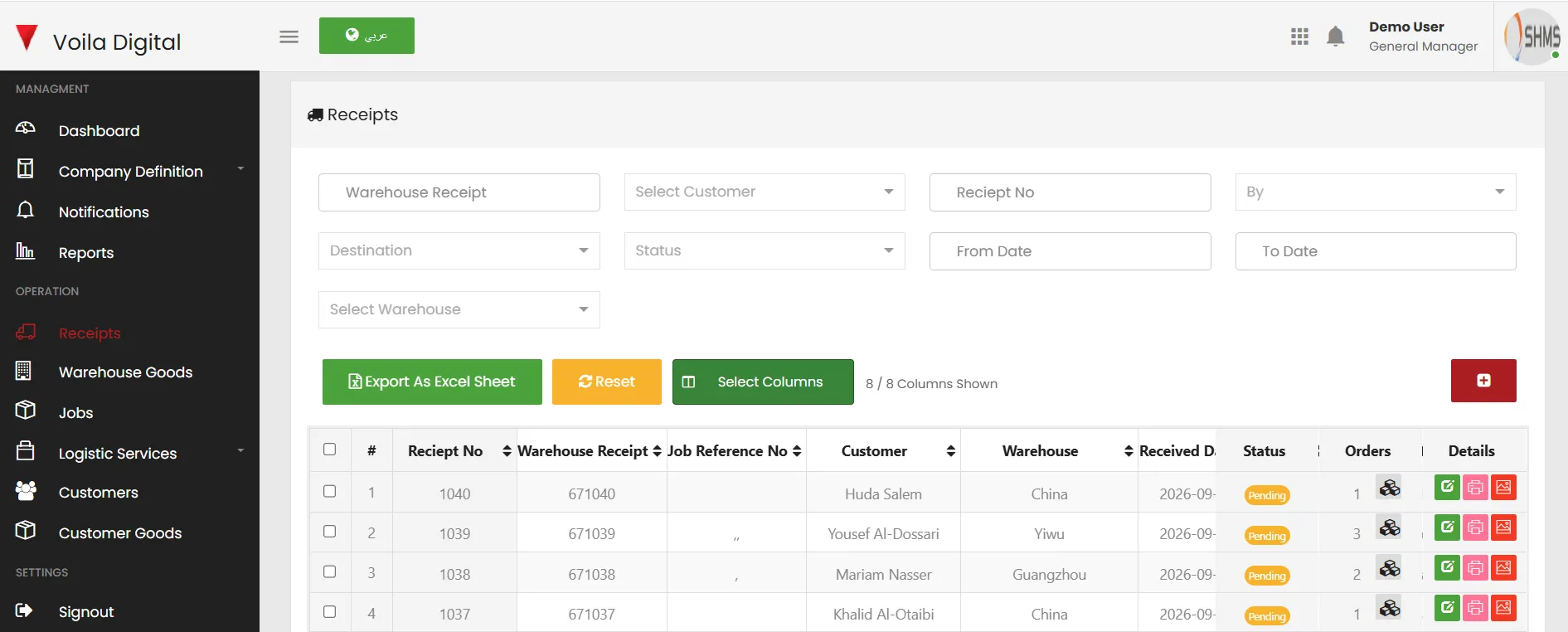
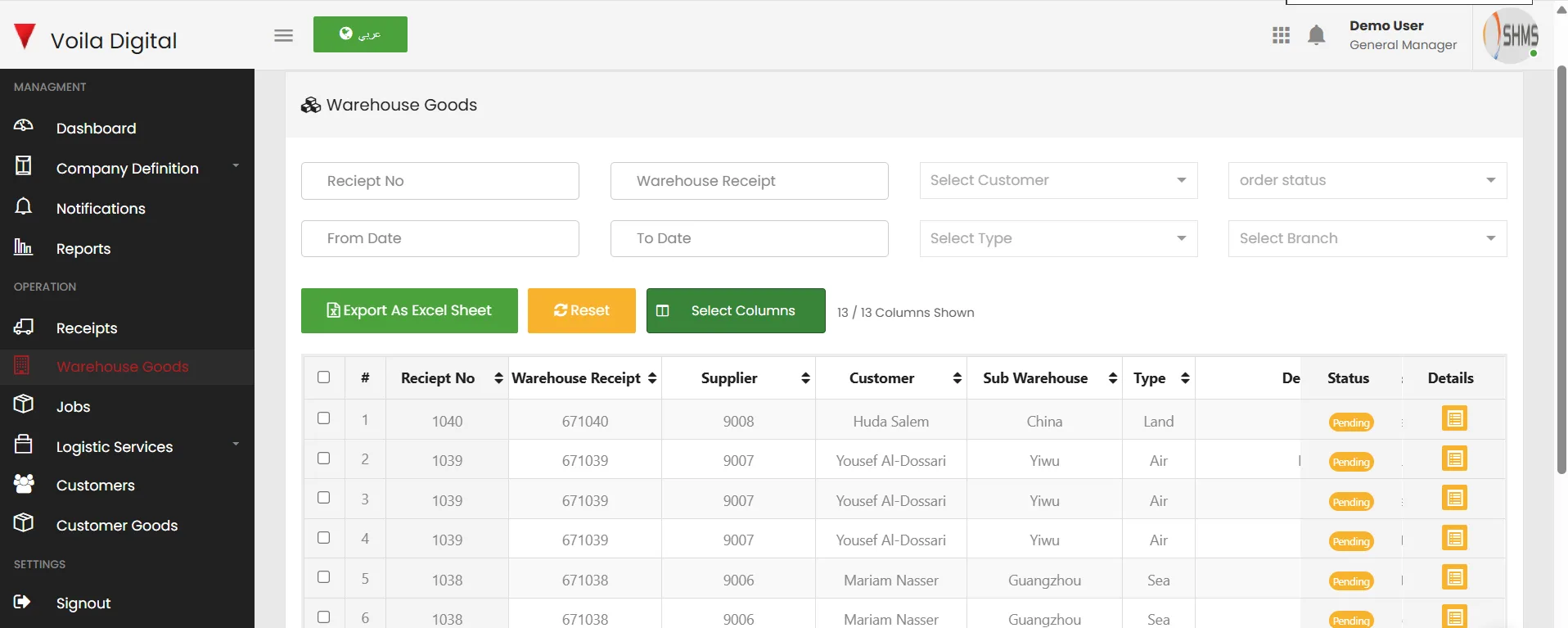
Warehouse Receipts & Goods
Operators register each drop-off as a receipt and add every good as a line item. The goods list shows every item across all receipts, with filters and status.
- Cartons, gross weight, dimensions, and volumetric weight per good
- Filter by customer, status, type, branch, and date
- Pending status until a mission is assigned
- Export lists to Excel
Transport Jobs & Manifests
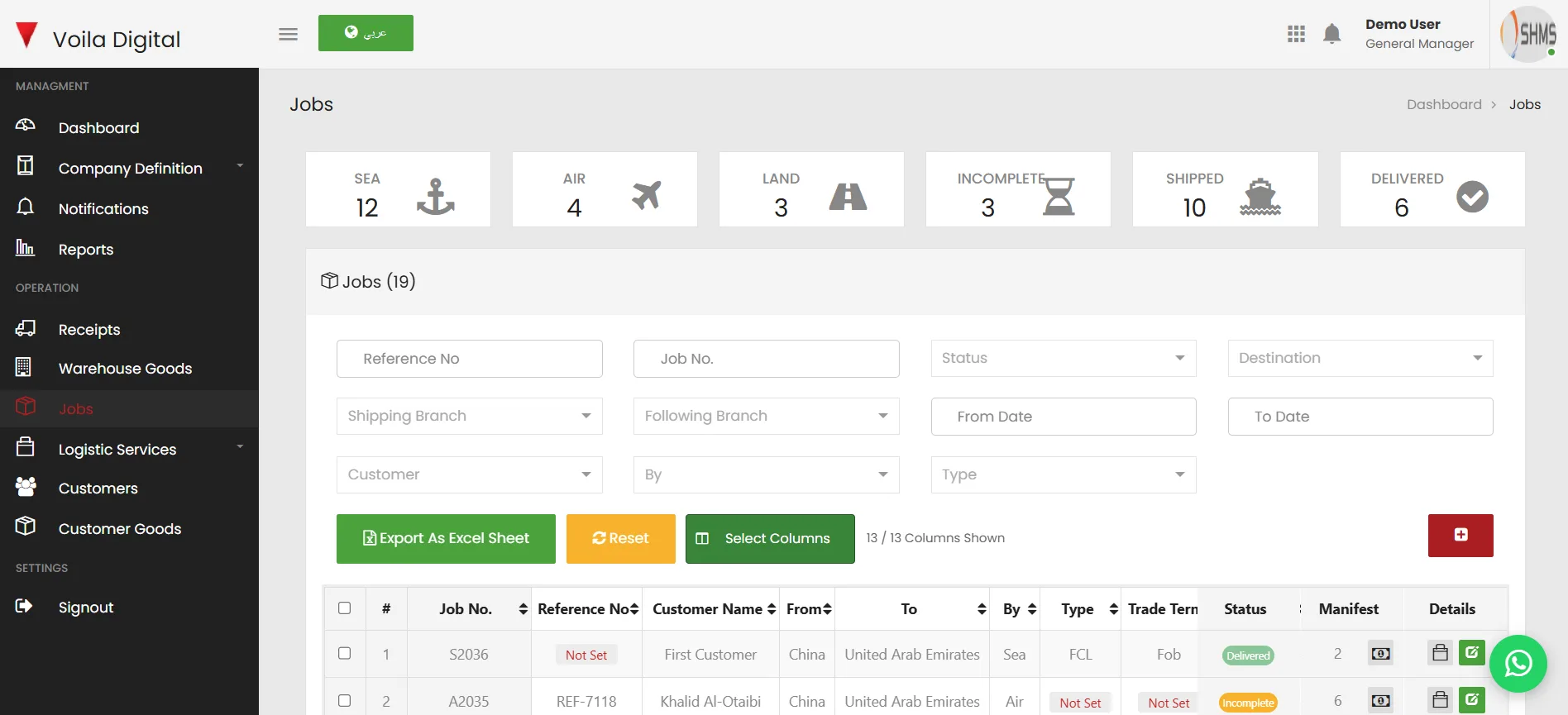
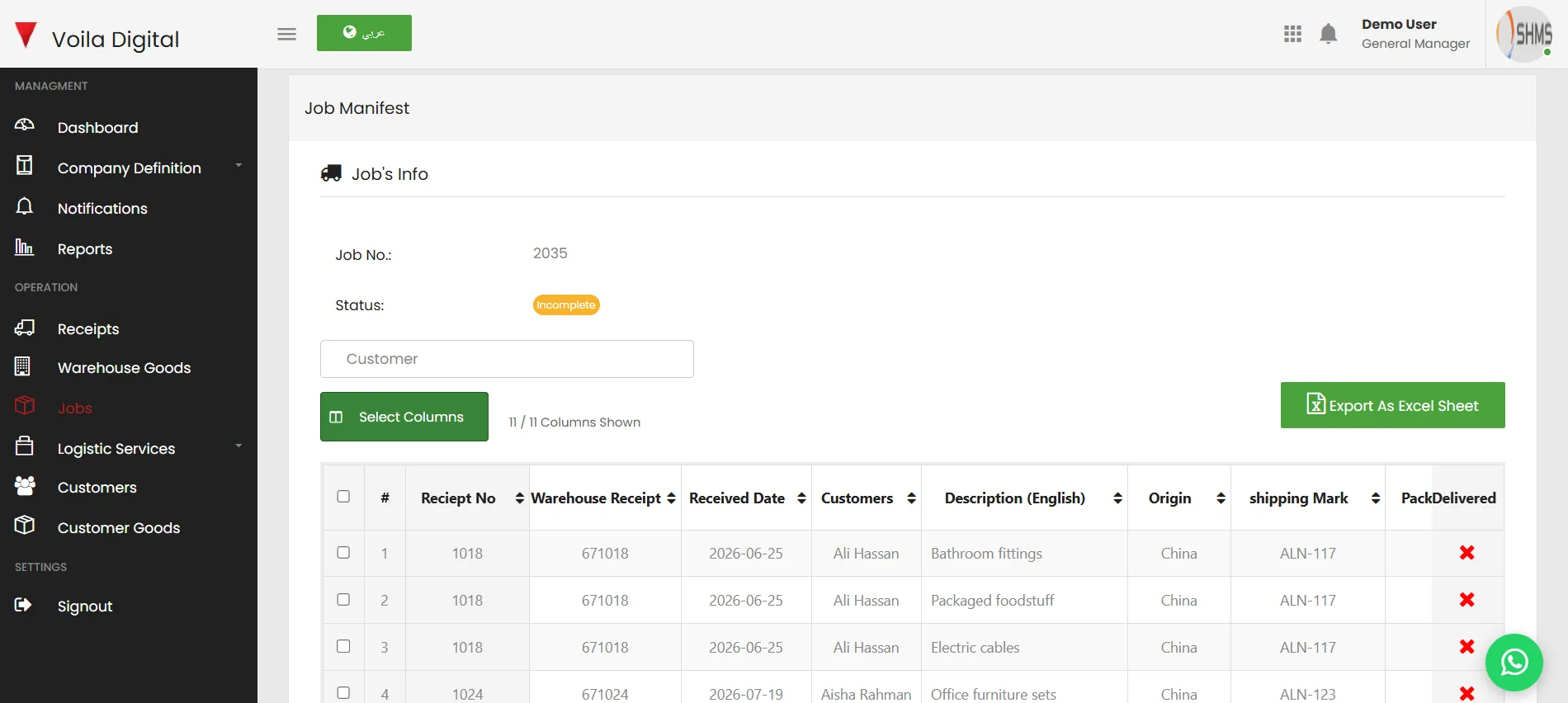
A job consolidates goods from one or more receipts into a single movement. Staff define the route and branch responsibilities, set ETD/ETA, and attach containers or trucks and the shipping bills.
- Sea, air, and land documentation in one workflow
- Separate shipping branch and clearing branch
- Statuses update automatically as goods are allocated and the job departs
- Transport manifest used to verify cargo on arrival
Import Licenses, Declarations & Bills of Lading
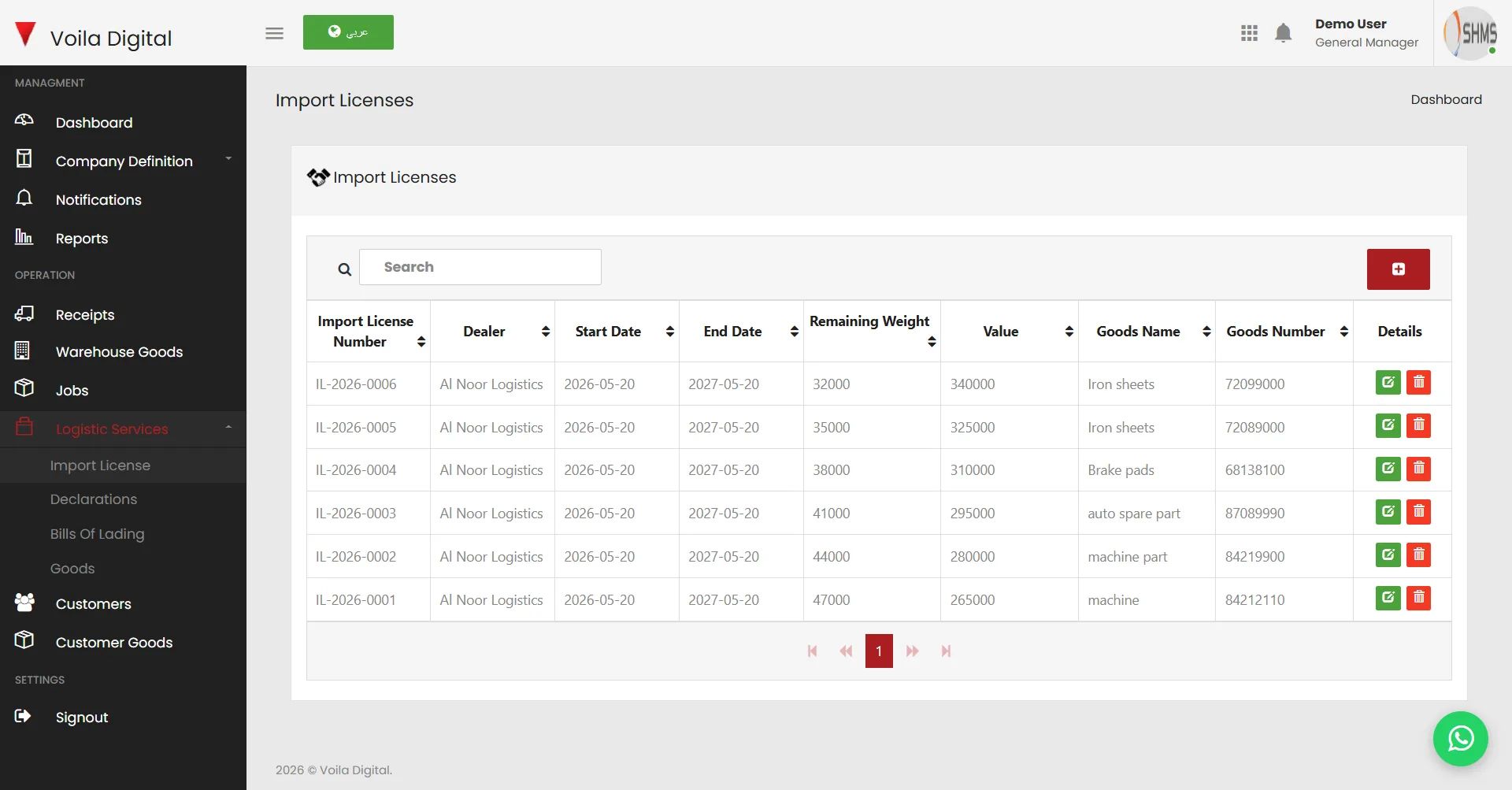
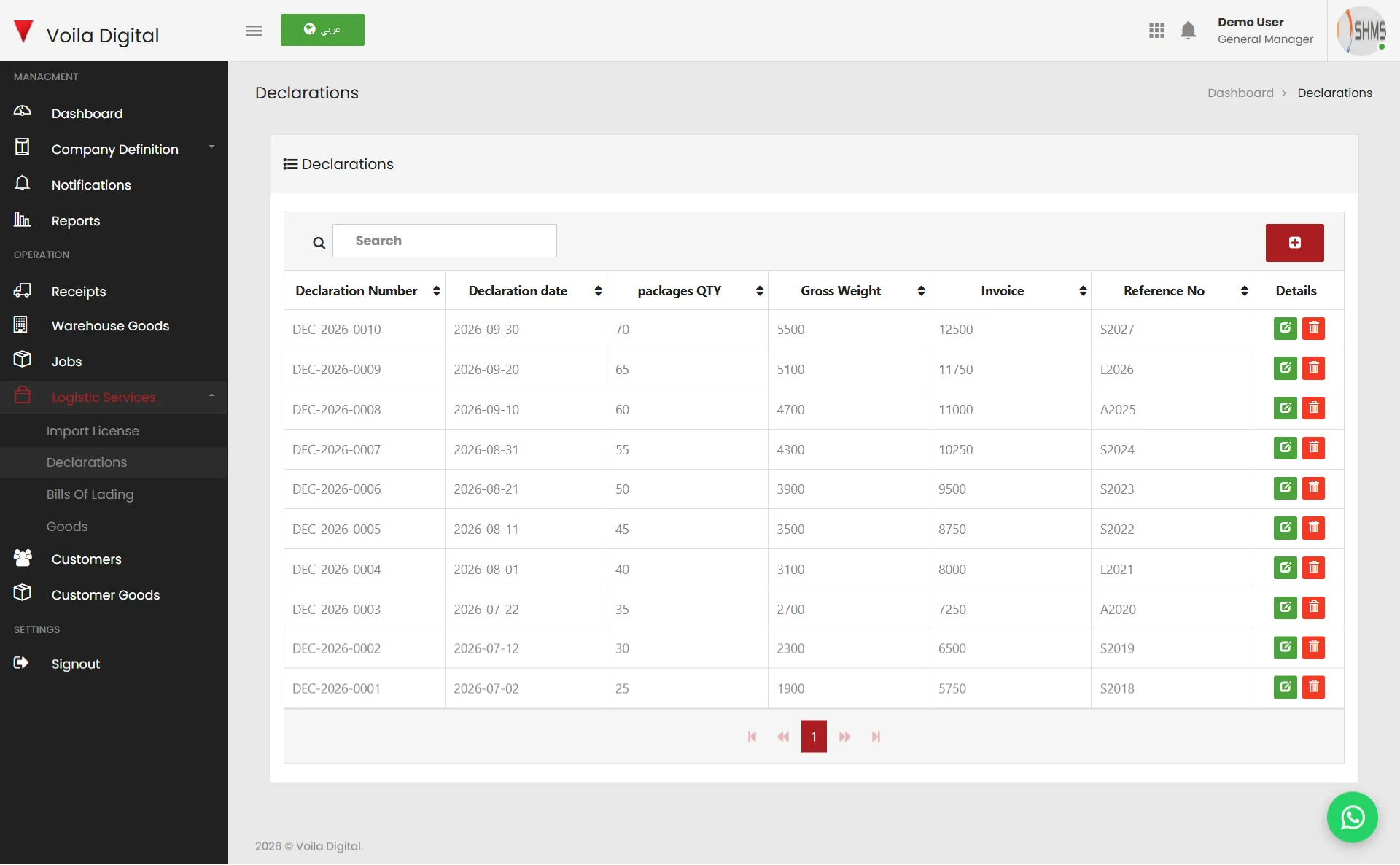
The Logistic Services area holds the legal paperwork. Licenses define the weight and value ceiling, and each declaration draws down from it during clearance.
- Validity dates, currency, and authorized goods on every license
- Available weight and value checked before each deduction
- Declared packages, invoice amounts, and clearing agents recorded
- Official clearance documents attached to the job
Reports & Excel Export
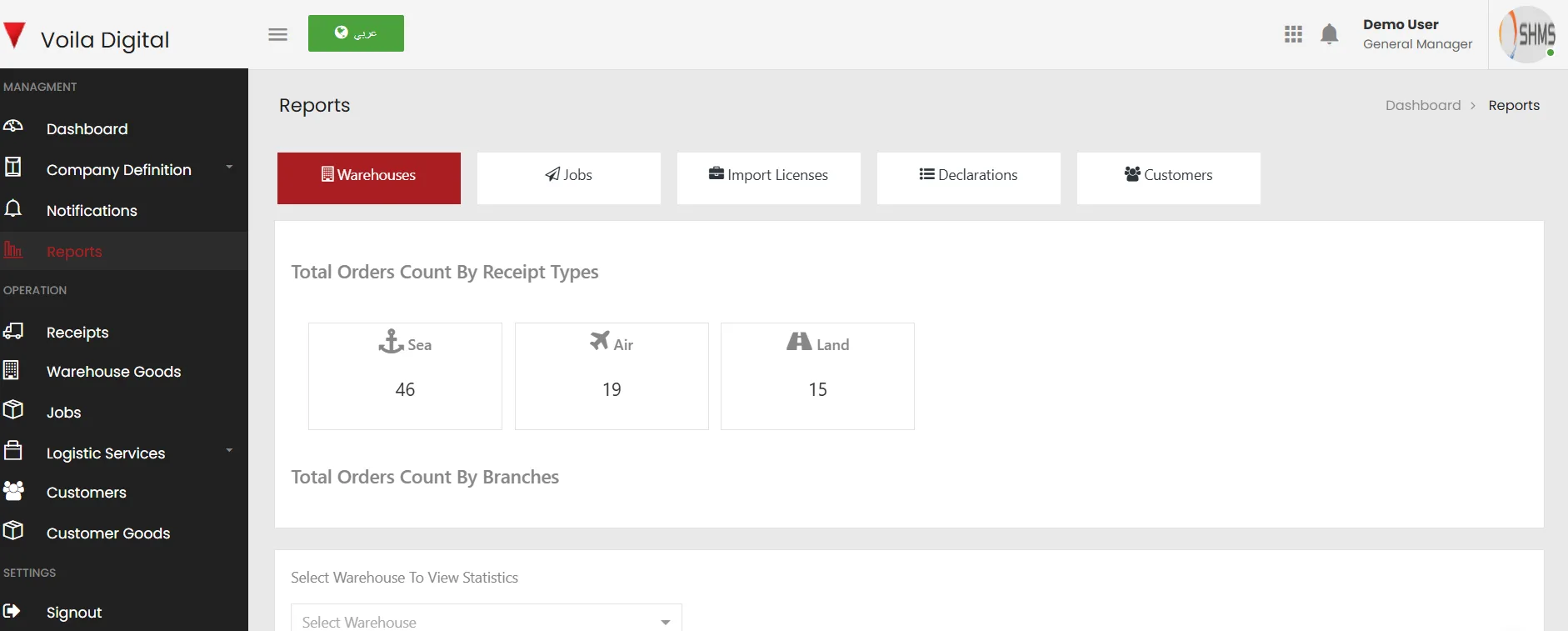
Daily operations turn into business insight, with exportable reports for management meetings.
- Reports across warehouses, jobs, licenses, declarations, and customers
- Every figure respects the manager’s branch and permissions
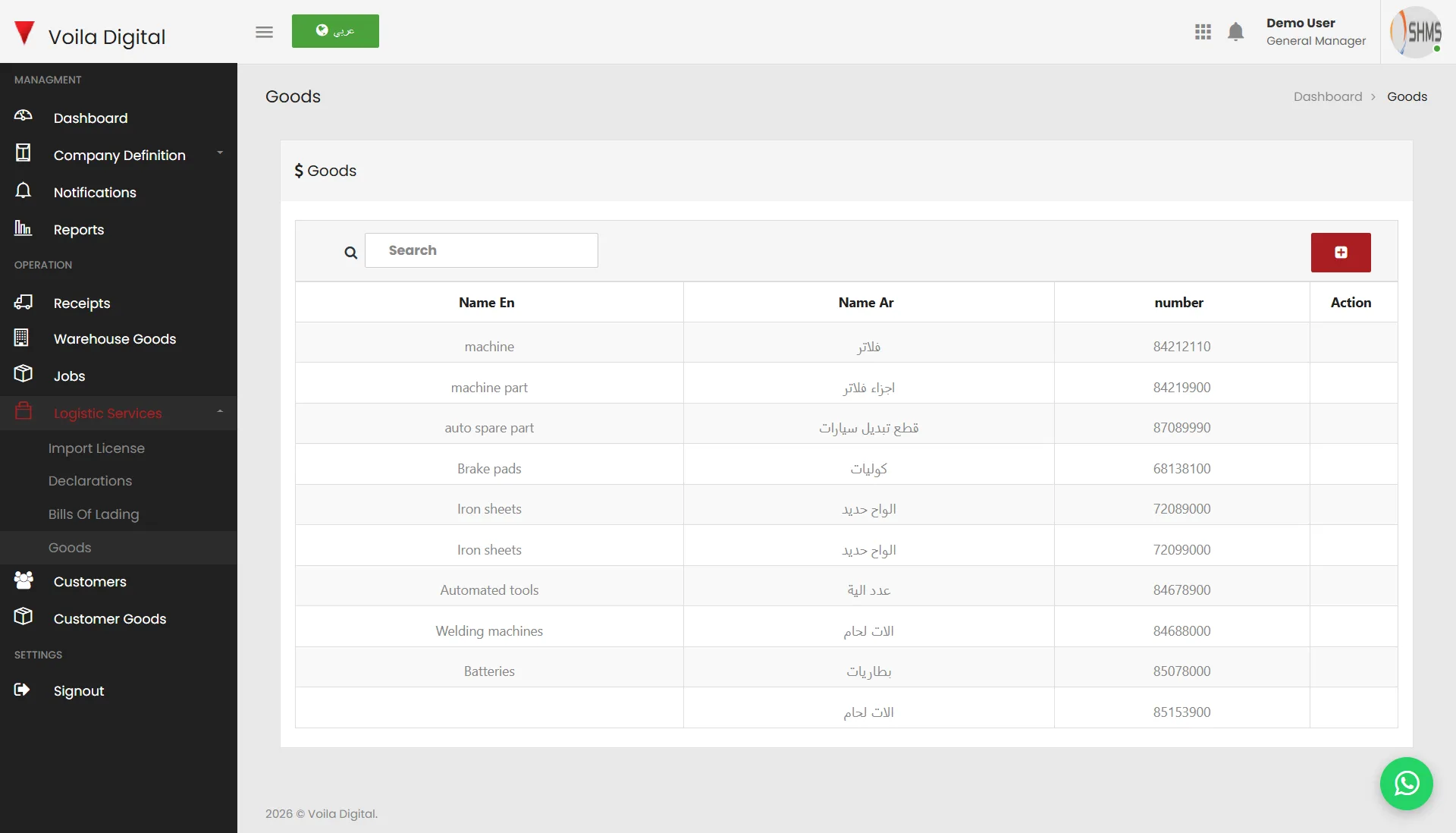
Goods Catalog with HS Codes
A bilingual goods reference with customs HS codes, assignable to each customer, so declarations start from consistent, correct classifications.
- English and Arabic names side by side
- Catalog assigned per customer
- Linked to import licenses and declarations

Scroll to zoom · Drag to pan · Double-click to toggle zoom
6 Strengths Built Into the Platform
Purpose-built for forwarders and clearance agents, not adapted from a generic ERP.
Automated Import-License Quota Control
The exact weight and value deducted from a client’s import license are recorded at each clearance event, so quotas are tracked in real time.
- Real-time remaining-weight balance per license
- Protection against fines and cargo seizures at the border
- Validity dates, currency, and authorized goods on every license
Branch-Scoped Role-Based Security
Permissions have two dimensions: what you can do, and in which branch. The same screen shows a China operator different data from a UAE operator.
- Permissions tailored to each branch and location
- Roles built from a visual permission matrix
- Dashboard widgets and menu items hidden without permission
Precise Auditability
Every action is tied to a real user. Automatic logging records every weight, dimension, and status change, with record-level tracking of who created and who updated each entry. This prevents fraud and unauthorized inventory alterations.
Every record shows who created and who last updated it
Automatic logging of weight and status changes
Linked records with full data integrity
Role-Broadcast Notifications
When a receipt is created or a job is sent, the system builds a bilingual message and delivers it live to every user in the configured receiver roles.
- Delivered live and stored in an in-app feed
- Unseen counter in the header, deep link to the record
- Routing configured per role at design time
Public Self-Service Tracking
Customers are external participants, not system users. Each holds an access code and checks the live status of their shipment by job number, with no login.
- Fewer status calls to your office
- Clients see the progress of their own shipment
- A modern, professional experience for clients
Bilingual, Multi-Branch & Multi-Currency
Full English and Arabic with right-to-left layout, switchable at login and in-app. Master data carries both names, and prices can be recorded in multiple currencies.
- Run China, UAE, Syria, Lebanon, or any branches in one system
- Cross-branch jobs are core to the design
- Excel export for lists and reports
A Multi-Layered Relational Model
Cargo is not treated as a single flat entry. Physical storage, transit packaging, legal ownership, and border processing are distinct, highly interconnected entities.
Key business entities
| Entity | Role in the system |
|---|---|
| Master Transport Job | The core operational anchor: an entire transit journey or consolidation mission, tying together goods, transport modes, shipping and clearing branches, ETD/ETA, and departure and clearance markers |
| Shipment Receipt | The intake receipt given to the client at drop-off, with customer and supplier details, receiving warehouse, and overall status |
| Granular Cargo Unit | The smallest trackable physical unit: carton count, gross weight, dimensions, volumetric calculations, description, markings, and warehouse position |
| Import License | A legal import permit issued to a trader, defining financial limits, weight ceiling, currency, authorized goods, and validity dates |
| Customs Declaration | The clearance record produced for border processing: declared packages, invoice amounts, clearing agent, and gross weight, linked to the job |
| Bill of Lading | Official transit and title document bound to a job: carrier line, container and seal numbers, departure and destination points, net and gross weights |
| Financial Clearing Link | The bridge between declarations and licenses, recording the weight and value deducted from a client’s quota at each clearance |
Value for Everyone Who Touches a Shipment
Management, employees, and customers each get something concrete out of the same connected record.
Management
- Live visibility across all branches
- Reliable volumes and status without asking
- Branch-level accountability and security
- Export-ready numbers for decisions
- Customs quotas that cannot be silently overrun
Employees
- No more duplicate data entry
- Automatic numbering and calculations
- Find any shipment or document instantly
- Clear handovers between branches
- Alerts so nothing is forgotten
Customers
- Track shipments themselves by job number
- Faster, more accurate answers
- Fewer surprises and delays
- A professional, modern experience
- Trust built on transparency
Reliable, Secure & Scalable
Designed for performance, audit compliance, and a responsive interface that works in the language each team member prefers.
Responsive Interface
A fast, dynamic, bilingual (Arabic / English) interface organized in feature areas that mirror the way your teams work.
Modular Design
Self-contained modules for operations, master data, and platform services, so the system grows with your business.
Data Integrity
Linked records and transactional safeguards that maintain a complete, trustworthy operational history.
Secure Access & Backups
Authenticated access with granular, branch-aware permissions, plus managed data backups.
See SHMS Running on Your Kind of Operation
Your competitors are already digitizing. The question is not whether to centralize your shipping operation, but how soon. Book a walkthrough and we will show the exact flow, from receipt to delivery to report, using scenarios from your business.
Request a Live Demo
See SHMS in action. One of our specialists will walk you through the full system, tailored to your shipping and clearance operation.
What to expect from your demo
Schedule a personalised walkthrough with our team and discover how SHMS can bring every branch, shipment, and customs document into one connected system.
- Live walkthrough from warehouse receipt to delivery
- Customs flow: import licenses, declarations, and quota tracking
- Branch-scoped roles, dashboards, and Excel reports
- Q&A session with a product specialist
- No commitment, completely free